You post a job and get flooded with applications. Half the resumes look like they’re written in code. Then you meet someone who seems perfect in the interview, but three months later you realize they’re just not working out. This constant cycle of hiring, training and replacing is exhausting, expensive, and takes time away from actually running your business. This is precisely where the concept of 360 recruitment enters the picture—it represents a genuine paradigm shift in approaching talent acquisition. In this guide you will get to know the 360 recruitment meaning and what makes it different from the regular options.
What is 360 Recruitment?
Before we go into this process of recruitment, what is 360 recruitment? Full-cycle recruitment—alternatively termed life cycle or end-to-end recruitment—offers a holistic approach where a dedicated recruiter oversees every element of the hiring journey. It spans from initial client consultations through to employee integration. Unlike fragmented traditional methods, this comprehensive strategy delivers consistency, bespoke service, and markedly improved outcomes.
Studies published via LinkedIn Pulse demonstrate how the 360 recruitment cycle effectively counters the pitfalls of gut-feeling hiring decisions, which frequently yield unsuitable appointments and excessive staff turnover. Instead, this methodology employs skill-focused, evidence-based techniques to ensure candidates and positions are genuinely compatible.
The essence of 360 recruitment lies in having a single recruiter shoulder responsibility for each phase of the employment process, encompassing:
- Collaborating with clients to clarify position requirements and organisational ethos.
- Identifying potential hires through professional circles, employment platforms, and social networks such as LinkedIn.
- Assessing and shortlisting applicants according to expertise, background, and cultural alignment.
- Handling compensation discussions to secure candidate commitment whilst adhering to client financial parameters.
- Facilitating smooth transitions to maximise retention prospects.
TeamDash indicates that this framework initiates when a position becomes available and extends until the new team member has comfortably settled into their role, often including the probationary interval. This stands in stark contrast to disjointed approaches where responsibilities are distributed amongst various personnel, potentially creating communication breakdowns and inconsistent candidate experiences.
The 360 Recruitment Process in Detail
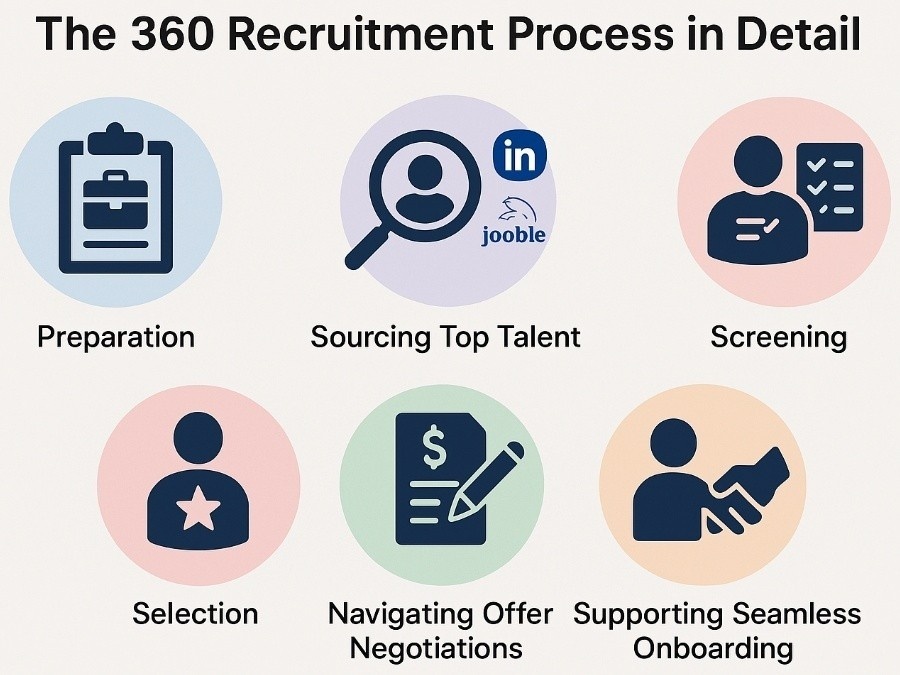
Breaking down this methodology reveals six crucial stages, each vital to achieving recruitment success:
Preparation: Defining Roles
Initially, comprehensive discussions with the client become essential to grasp the corporate culture, role-specific demands, and attributes that characterise an ideal candidate. As Adri Solutions notes, this foundational step ensures recruitment efforts align with business goals. Consider how varied these requirements can be—whilst tech startups might value innovation and adaptability, financial institutions typically prioritise regulatory awareness and meticulous attention to detail.
Sourcing Top Talent
While recruiters rely solely on standard job postings, 360 recruitment specialists take a more active approach to finding great candidates. They tap into their professional networks and engage with potential talent on platforms like LinkedIn. It is better to reach out directly to talents who might not be in search of a new job but are drawn to a compelling opportunity. According to recent research from Square One Resources, it shows that 90% of professionals are open to advancing their careers. However, only 36% are actively searching for new positions so it highlights just how crucial it is to actively seek out and connect with talented individuals.
Screening
The evaluation phase encompasses thorough CV assessments, preliminary telephone conversations, and formal interviews to determine optimal matches. An interview 360 recruiter functions as something of a human lie detector, penetrating rehearsed responses to evaluate genuine capabilities and disposition, confirming workplace compatibility. AllSorter points out that this rigorous approach significantly reduces hours wasted on fruitless interviews, thereby enhancing operational efficiency.
Selection
When choosing new team members, recruiters assess how well applicants fit the company’s cultural environment and core principles. They look at whether they have the specific abilities required for the position. These 360 recruiters use several approaches to identify top talent. They conduct trial work sessions and evaluate personality traits. They meet with people from the different departments as well. The selection process typically wraps up when an offer letter is sent. It then moves the successful candidate from an applicant to a new hire.
Navigating Offer Negotiations
Upon identifying the right candidate, the recruiter orchestrates delicate negotiations to secure acceptance without exceeding the client’s financial constraints. This entails discussing remuneration packages, benefits, and employment terms diplomatically. It ensures both parties conclude arrangements feeling properly valued. As AIHR emphasises, the recruiter plays a pivotal role in balancing organisational limitations against candidate requirements.
Supporting Seamless Onboarding
Following acceptance, the recruiter maintains involvement throughout the integration process. This includes liaising with human resources departments, addressing newcomer concerns, and confirming access to essential resources for success. According to HeroHunt, this continued engagement helps prevent common issues that might otherwise trigger premature departures, thereby fostering long-term retention.
Benefits of 360 Recruitment
Your recruiter develops remarkable skills at identifying perfect matches for your unique workplace. Your candidates experience a personalized process rather than feeling processed through an impersonal system with recruiters who can’t remember their backgrounds.
The 360 model offers several advantages, backed by both research findings and real-world examples:
Improved Quality of Hire: When recruiters thoroughly understand client and candidate needs, they naturally make more precise matches. Consider a scenario where a consultant identifies a candidate whose leadership approach dovetails perfectly with a company’s collaborative culture, substantially mitigating potential workplace friction.
Enhanced Efficiency: Having streamlined communications and a dedicated point of contact markedly reduces delays and misunderstandings throughout the hiring process. Navado Talent’s research suggests this approach can slash time-to-hire by up to 20% in certain circumstances.
Better Candidate Experience: Job seekers truly value it when they have a single point of contact throughout their recruitment journey. It gives them a more personal and cohesive experience. Research by 360-Recruitment suggests this personalised approach frequently results in higher offer acceptance rates, largely because candidates feel genuinely valued and respected during the entire process.
Reduced Turnover: Careful selection processes paired with dedicated support during the critical initial employment period help new staff properly integrate into their positions. Research conducted by Raymond George Consultancy reveals this method can lower turnover figures by roughly 15%, bringing substantial workforce stability to organisations.
Cost Savings: By avoiding rushed hiring decisions and minimising staff departures, companies stand to achieve notable financial benefits. Recruiters must consider that replacing a mid-level team member typically costs an organisation up to 150% of their yearly salary. Hence, it is quite a compelling case to ensure that recruitment is done properly from the outset.
Challenges and Solutions
Let’s be honest – the 360 recruitment model demands exceptional dedication. Consultants must balance numerous tasks, from crafting compelling 360 recruitment job adverts to calming nervous candidates before their interviews. The most effective professionals enhance their performance through modern technology, exceptional time management, and a steadfast commitment to professional development. Their true distinction lies in cultivating enduring professional relationships rather than pursuing quick placements.
While advantageous, 360 recruitment presents hurdles requiring thoughtful solutions:
High Workload: Handling the complete recruitment cycle can prove incredibly taxing, particularly when managing several vacancies at once. Without adequate backing, this pressure may result in consultant burnout.
Diverse Skill Set Required: Thriving in this field demands proficiency across multiple areas – spanning client relationship nurturing and talent sourcing to interview techniques, negotiation skills, and human resources advisory capabilities.
Solutions:
Time Management: It is better to adopt a robust organisational method. This includes structured task prioritisation and clever scheduling applications, which can assist consultants in effectively handling their multifaceted responsibilities.
Continuous Learning: Progressive recruiters embrace ongoing skill development, whether through industry seminars, targeted certifications, or keeping informed about evolving recruitment methodologies.
Support Systems: Businesses must provide sufficient infrastructure, including access to sophisticated recruitment platforms and ensure consultants maintain realistic caseloads to consistently deliver exceptional results.
Collaboration: Usually the 360 recruitment consultant serves as the primary point of contact. So, there needs to be a strategic collaboration with colleagues. This way, relevant departments can yield valuable insights and share their expertise.
Comparing 180 and 360 Recruitment
So what is the difference between 180 and 360 recruitment? You might encounter discussions about 180 recruitment among recruiters who select only convenient aspects of the process. That is, if quality isn’t your priority, but if it is quality you want—recruitment 360 delivers better.
To understand the 360 recruitment process fully, it’s better to compare it with the 180 recruitment meaning. It is where the process is split between different roles, such as account managers for client relationships and recruiters for candidate placement.
| Aspect | 180 Recruitment | 360 Recruitment |
| Process Management | Split between multiple team members | Single recruiter handles all stages |
| Communication | Potential for gaps and miscommunication | Streamlined, consistent communication |
| Specialization | High, with each role focusing on expertise | Broad, requiring diverse skills |
| Scalability | Easier to scale with additional specialists | May be limited by recruiter’s capacity |
| Candidate Experience | Potentially less personalized | Highly personalized and consistent |
Pros and Cons:
- 180 Recruitment: Offers specialization and scalability but may suffer from communication gaps and less personalized service.
- 360 Recruitment: Provides consistency and deep understanding but demands a high workload and diverse skills.
When to Use Each:
- 360 Recruitment: Ideal for roles requiring high specialization or a personalized touch, such as executive searches or niche technical positions.
- 180 Recruitment: The recruitment cycle is suitable for high-volume hiring or when standardization is preferred, such as in large organizations with standardized roles.
Best Practices for Implementation
Now that we’ve looked at 180 vs 360 recruitment, what is the best recruitment cycle? Working with skilled 360 recruiters means you are in a partnership with people who have skills and experience. They read between the lines of vague job descriptions and notice when candidates stretch the truth on their resumes. These recruiters pick up on those subtle pauses during interviews that often reveal more than words.
What truly sets them apart isn’t just their impressive professional networks or any cutting-edge recruitment tech—but their genuine interest in getting the best hire. They’re invested in successful outcomes and not just placements.
From experience working with recruitment teams across various industries, these approaches consistently deliver better results:
- Clear Communication: Honest, straightforward conversations create trust with hiring managers and candidates. When everyone has accurate information and realistic expectations, the whole process runs more smoothly and produces better matches.
- Use Technology: The best recruiters balance human intuition with smart tools. Modern applicant tracking systems and well-implemented AI sourcing solutions aren’t just shiny objects—they free up your recruiters to focus on the human elements that truly matter in finding the right fit.
- Continuous Evaluation: The market evolves constantly, and your recruitment approach too. Take time quarterly to evaluate what’s working and what isn’t. Look for bottlenecks, examine feedback patterns, and make adjustments before small issues become significant problems.
- Set Key Performance Indicators (KPIs): Move beyond basic metrics and focus on indicators that reflect true success. Yes, time-to-hire matters, but retention rates, hiring manager satisfaction, and candidate experience often tell a more complete story about your recruitment effectiveness.
- Professional Development: The best 360 recruiters never stop learning. Investing in their growth through training in negotiation tactics, behavioural assessment, or industry-specific knowledge strengthens every facet of the recruitment cycle and improves your results.
Conclusion
At its core, 360 recruitment offers a holistic approach that can truly transform team building. With an experienced 360 consultant overseeing the entire recruitment process, organizations often see stronger candidate matches, more efficient workflows, and better experiences for everyone involved.
Like any strategy, it comes with challenges and so recruiters must have a diverse skill set to juggle complex workloads. Stay flexible, keep evaluating, and focus on building genuine connections—that’s where the true value of 360 recruitment is always found.