
A company can pay temporary employees or contractors through PAYE or Umbrella. The differences between these two systems are important for workers, recruiters, and employers to understand.
The UK’s number of contract workers has steadily increased since the 2000s. Currently, there are about 1.9 million contract workers in the country, which is up by a third compared to 2008, according to a 2015 analysis by John Kitching based on Labour Force Survey data.
In light of the changing employment landscape, professionals must differentiate IR35 regulations and compliance issues, as well as umbrella company vs. PAYE principles. This article will cover both ways of payment and their pros and cons.
What Is Umbrella Pay, and How Does It Work?
A payroll umbrella company is a business that employs temporary workers for a third party. While the contractors perform the job for one business, they are directly employed by an umbrella company. It usually concerns workers under IR35 regulations.
For example, a business needs a project employee. It works with a recruitment agency to find a contractor who will be employed and paid through an umbrella company. The umbrella company handles payroll, taxation, and compliance for these employees.
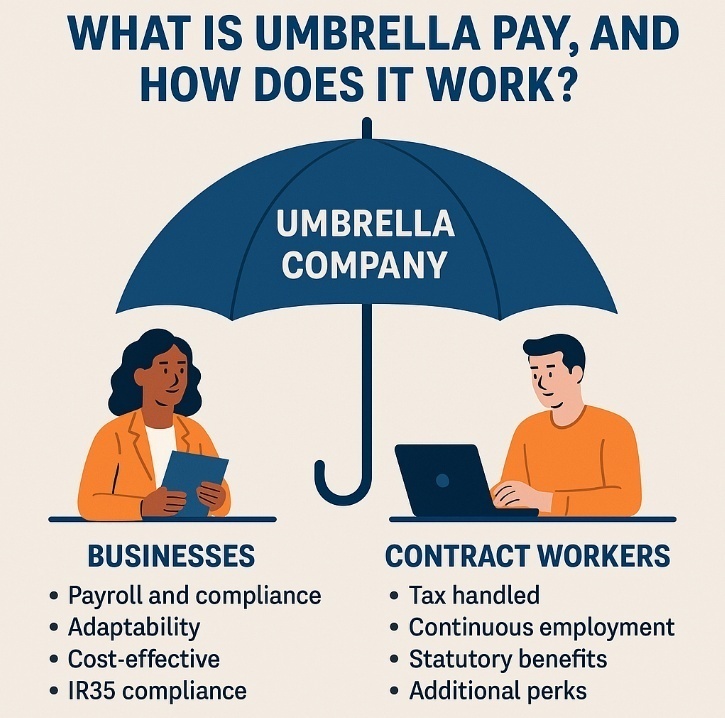
Umbrella employment has several benefits for businesses, namely:
- The administrative tasks in relation to temporary workers go to the umbrella company. It takes care of payroll, taxes, deductions, onboarding, etc;
- It helps businesses to adapt faster to growing workloads and scale up;
- It is usually more financially beneficial than growing an in-house payroll team;
- It ensures legal compliance with IR35 and HMRC guidelines.
The umbrella payment has a lot to offer to contract workers as well:
- A freelancer or contractor doesn’t have to handle the taxes independently. Umbrella company takes care of it;
- It counts as continuous employment, which is essential for mortgage applications;
- It provides statutory benefits and holiday pay (covering sick leave, parental leave, and pension contributions);
- A lot of umbrella companies provide additional benefits like professional training, health insurance, or discount programs;
- Legal protection and compliance.
What Is a PAYE Contract, and How Does It Work?
PAYE is an HMRC payment system for contractors who are directly employed. It stands for Pay-As-You-Earn and regulates the income tax National Insurance collection.
Basically, workers under IR35 have to choose between an umbrella company or PAYE. In the second option, a professional calculates, deducts, and sends their taxes to HMRC directly. In the case of an umbrella company, it is the company’s responsibility.
Recruitment agencies often work as PAYE agencies as well. This means that while workers do the job for a business, a recruitment agency handles their payrolls and taxes under the PAYE system. The PAYE system gives workers access to sick or paternity pay after 12 weeks of employment.
Umbrella vs PAYE: Key Differences
The main difference is in the employment. PAYE is a direct model with a hiring organization, while Umbrella is a third-party employment model.
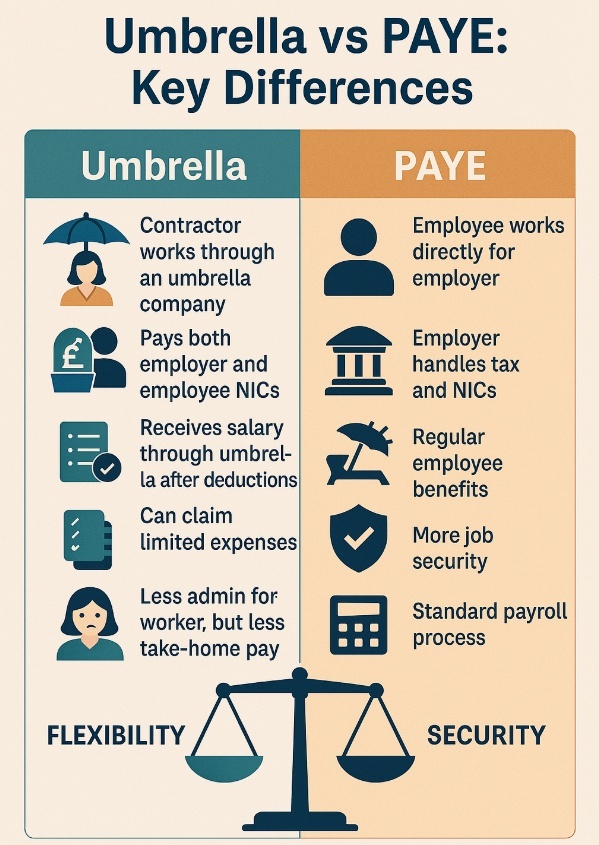
The main similarity is that with both of them, the worker gets a salary with all deductions done already. Taxation happens in the same manner but an umbrella company usually takes a fee for its services. That’s why an umbrella rate is higher than a PAYE rate. The fee is paid by the company of the worker who performs the job. So the net salary a specialist receives is the same.
Here is an example of an umbrella vs pay calculator
Let’s say a person receives £250 per day. The weekly invoice is £1,250.
Umbrella company deducts: employer NI of £138.79, apprenticeship levy of £5.46 and umbrella fee of £12.5. As a result, the taxable salary of an umbrella employee is £1,093.25
PAYE is £316.39, and employee NI is £55.69. The net pay is £721.17.
It is important for workers to understand the net pay. If the offered rate is lower than PAYE, it is more profitable to work with an umbrella company.
An umbrella payment is higher for a business that is looking for a contractor. At the same time, the cost comes with the advantages of not worrying about payroll, compliance, margins, and administrative costs. Umbrella companies handle invoicing, timesheets, and all administrative tasks. So if the net pay is smaller for workers, it also comes with a benefit. The worker does not have to handle that on their own. Plus, contractors get constant employment and statutory benefits.
Which one is better PAYE or Umbrella?
There is no distinctive answer, as it depends on the goals and purposes of a contractor and a business. Both models are valid and have their benefits and limitations.
IR35, Compliance Considerations and Risks
IR35 is a taxation legislative norm introduced in 2000. It ensures that on-payroll and off-payroll workers pay the same fair taxes. Under this regulation, contract employees are subject to the same taxation system as permanent employees.
Previously, contracts decided on their own whether they were working under IR35. However, since April, this has been determined by the end client, thus the receiver of the services.
It is defined before two parties make the contract. The liability for correct tax and insurance dedication now lies on the end client. It can be a business, a PAYE agency, or an umbrella company.
This change will affect mid-size and large businesses, while small ones are exempt. Liability and compliance put more pressure on end clients, so they might be more interested in working with an umbrella company. The main issue is finding a credible provider.
Choosing the Reliable Umbrella Company
Finding a credible umbrella company is of high interest to businesses and recruiters. The compliance risks are relatively large if it is not a reliable company.
As the number of umbrella payroll companies is increasing, it might be challenging to filter out the shady ones initially. However, there are several factors to consider:
- FCSA accreditation is the first thing to look for regarding a reliable provider. Start with the list of accredited umbrellas;
- HMRC guidelines compliance;
- Pay attention to fees – they must be transparent;
- Efficient and fast payroll processing procedures;
- There should be no over-complicated calculations or tax avoidance practices;
- Reputation and track record are other vast indicators of a provider’s legitimacy. Pay attention to what previous partners and contractors say about the umbrella.
- Extra benefits for workers are always a good sign of a reputable umbrella.
Recruiters may be responsible if they refer workers to unreliable or rouge umbrella companies. That’s why there must be deep research into the providers before referring anyone. It will lead to significant problems for all parties involved if an umbrella company fails to comply with tax legislation.
Key Takeaways
There is no one right answer to the PAYE vs. umbrella debate, as both have pros and cons. However, working with an umbrella company might be safer for a business and a contractor. Hence, it is a credible and reputable service provider. At the same time, it comes with additional costs, mostly for businesses but also for contractors.
So, the choice is individual, but recruiters must understand all the intricacies of tax legislation and compliance in order to offer businesses and talent-appropriate deals.
Sources
Contractor Calculator. (n.d.). More than 3 million self-employed in the UK as contracting rises across Europe. ContractorCalculator.co.uk. Retrieved April 3, 2025, from https://www.contractorcalculator.co.uk/contractor_numbers_contracting_landscape_europe_506510_news.aspx
HM Revenue & Customs. (n.d.). PAYE for employers. GOV.UK. Retrieved April 3, 2025, from https://www.gov.uk/paye-for-employers
UK Finance. (n.d.). IR35 explained. UKFinance.org.uk. Retrieved April 3, 2025, from https://www.ukfinance.org.uk/news-and-insight/blogs/ir35-explained
F-ndr. (n.d.). Umbrella companies in the UK. UmbrellaCompany.f-ndr.com. Retrieved April 3, 2025, from https://umbrellacompany.f-ndr.com/c/