
The Royal Guards have always been and will always remain an object of high interest for tourists. Everybody associates them with huge fur hats, also known as bearskin hats, red-and-black uniforms, and robotic movements, but this knowledge is rather superficial. Only some people know what is going on behind the scenes.
If you’ve ever wondered how one can become a member of the Royal Guards or how much money they normally get, make yourself comfortable and keep reading our article. Here, you’ll find a comprehensive review of the Royal Guard role and the intricacies this job implies.
Regional Variations of Queen’s Guard and What they Do?
Even though the Royal Guards are primarily famous for performing ceremonial duties, they are real soldiers. They belong to the British Army, and many of them do have prior combat experience.
By the way, it’s not only the Guards of Buckingham Palace that belong to the Royal Guard. Soldiers tasked with guarding other royal residences in the United Kingdom also belong to this honourable group:
- The Grenadier Guards, the Guard of Honour of King Charles III (used to be of Queen Elizabeth II) and the whole British Royal Family;
- The Coldstream Guards, have a ceremonial role as protectors of the royal palaces;
- The Scots Guards, the Scottish Regiment of Foot Guards;
- The Irish Guards, the Irish Regiment of Foot Guards;
- The Welsh Guards, the Welsh Regiment of Foot Guards.
Guardians of Royalty: Duties and Responsibilities
The history dates back to the fifteenth century. King Henry VII turned his own Guard into a permanent institution and conferred a title on it. Initially, they had been known as “the Yeomen Guard”, but during the Victorian era, the name was altered to “The Royal Guard”. Their primary mission was to escort and guard the monarch. At that time, the Guard had no ceremonial role, as we can observe nowadays.
Preserving Tradition: Ceremonial and Symbolic Duties
The ceremonial tradition was introduced almost two centuries later, at the end of the 17th. Nowadays, there is a wide range of events the Royal Guard has to perform at, including:
- The annual Royal Maundy Service;
- The State Opening of Parliament;
- The Epiphany Service in the Chapel Royal at St James’s Palace;
- Summer Garden Parties at Buckingham Palace;
- All the investitures, coronations, lying-in-state, and funeral of the Sovereign.
Inside the Royal Guard Selection Process
The cases of the Royal Family’s guards collapsing during rehearsals or even at events in front of the public are not rare. Even though the Buckingham Palace security representatives hide it behind a poker face, their bodies can’t lie: their service is both physically and mentally demanding or exhausting. Let’s find out what a soldier has to go through before being hired as a member of the Royal Family’s Security Guard.
Rigorous Training
First and foremost, it’s not the Palace that employs the Guards; it’s the British Army. To get any army role, a person has to pass BARB, the British Army Recruit Battery test, and get at least 26 points. The Guard members are usually infantry and cavalry soldiers, who typically belong to the oldest and most prestigious infantry regiments in the British Army. The training in self-discipline, teamwork, and fitness they receive is truly harsh. Moreover, all of them have had experience in combat zones.
However, one without any experience can join the Guard too. According to the information we’ve found on the official British Army Jobs website, to join the ranks of guardsmen without prior experience, one is required to:
-
- Take a Combat Infantry Course (30 weeks) at The Infantry Training Centre Catterick, where an applicant does their Basic Training and then Infantry Initial Trade Training. The training is aimed at teaching essential skills such as firing weapons, survival, first aid, and map reading as well as building stamina and fitness.
NB: Candidates under 17 years and 6 months do Basic Training at the Army Foundation College Harrogate for 49 weeks (instead of 30) and then go to Catterick to complete Infantry Initial Trade Training over 12 weeks.
- Having completed Initial Trade Training, candidates move to Foot Guards Battalion where they are also prepared for operations abroad and State Ceremonial duties.
Qualifications
The good news is that according to the official British Army Jobs website, anybody from 16 years & 0 months to 35 years & 6 months can apply to become a guardsman or guardswoman. One has also to meet basic physical fitness requirements:
- Mid Thigh Pull 76kg
- Medicine Ball Throw 3.1m
- MSFT (beep test) level 8.7.
Another good thing is that no formal qualifications are needed at entry. On the completion of the preparation course, graduates get such qualifications:
- Vocational Driving Licences;
- HM Forces Serviceperson (Protective Services) Apprenticeship;
- Leadership and Management qualifications to degree level;
- Assessor qualifications;
- Coaching and mentoring;
- Adventure Training Qualifications (Canoeing, Mountain Biking, Skiing, Mountain Climbing, Summer Mountain Training).
Key Skills Emphasized in Training
Being a member of the Royal Guard may be less demanding than being sent to combat zones; however, the King or Queen’s Guard can’t fall behind in their fitness and stamina. It may also seem to be the key skill, but the Royal Family Guard members are also expected to possess highly developed teamwork, leadership, and communication skills.
- Teamwork. Royal Guards are members of a military setting, and teamwork is always the fundamental requirement there. Whether it’s performing, marching, or overseas missions, a strong sense of teamwork and support between comrades is crucial for their success.
- Leadership. In the Royal Guard, there is also the need for guiding, mentoring, and leading others. Those soldiers who possess these skills get a chance of promotion to more senior military ranks.
- Communication. Soldiers have to deal with high-pressure, unstable, or dangerous environments. Communicating your ideas clearly and effectively, regardless of external factors and influences, is extremely important.
Unveiling the Royal Guard Compensation
Even though being a representative of the Royal Guards is genuinely honourable, it’s a job that has to be decently paid. Having learnt how much skills, training, and preparation this role requires, let’s find out if it’s worth the effort money-wise.
Royal Guard Salary 2023
Responses to the question ‘How much does a royal guard make?’ are quite common in British Google search results. In an ongoing effort to recognize the dedication and service of military personnel, there has been a significant revision in their pay structure.
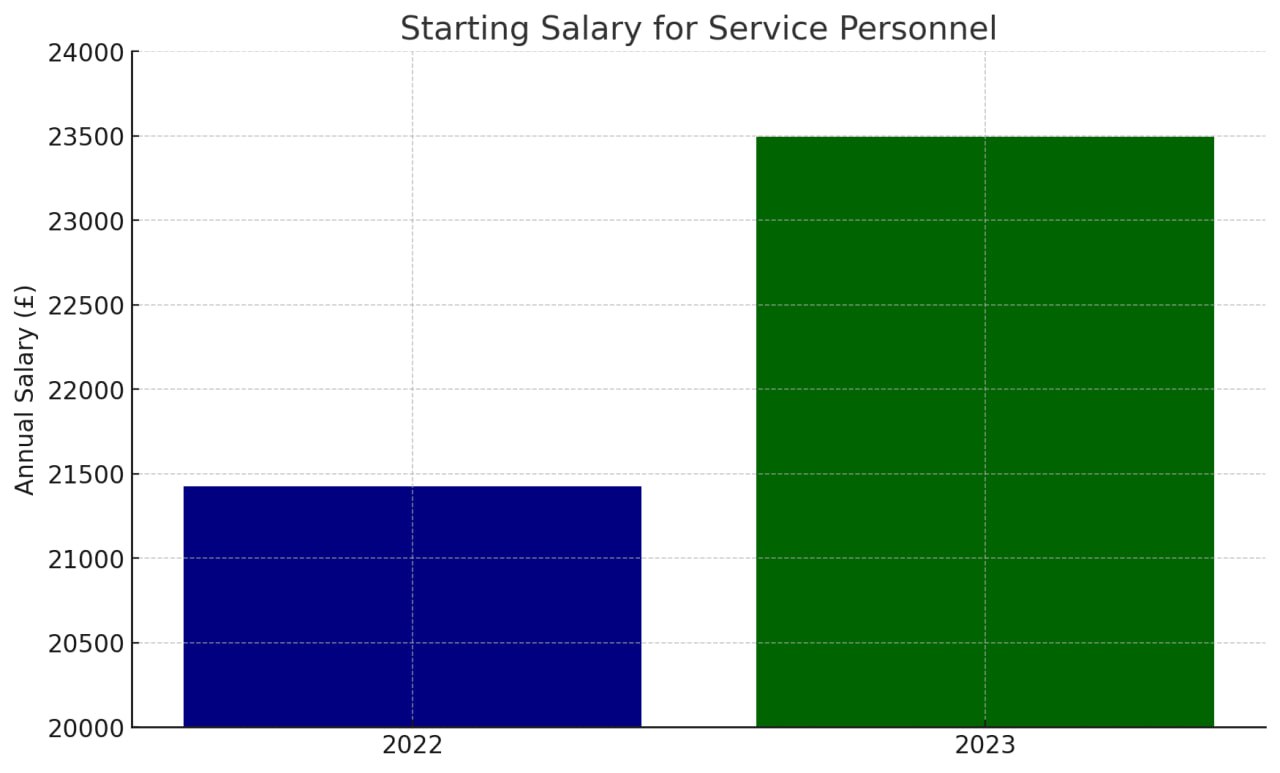
From 1 April 2023, individuals beginning their service careers, following their training phase, will witness their starting salary elevated to £23,496. This increment, which applies retroactively, marks a significant rise from the 2022 starting salary of £21,425, as represented in the infographic below.
According to the official British Army Jobs website, the annual salary of a trainee is £18,687. On the completion of the 26-week service or basic trade training, the pay rises to £23,496.
The Soldiers’ salary after the initial training:
- Private: £23,496 a year
- Lance Corporal: £30,769 a year
- Corporal: £35,718 a year
- Sergeant: £40,058 a year.
The list of benefits usually includes subsidised meals, low-cost accommodation, paid leaves, and free medical and dental care. The Army covers all pension contributions. Soldiers usually don’t pay for anything when deployed on exercise or operations.
Additional Perks and Privileges
If talking about non-monetary benefits, they are:
- Training skills for life: If a person chooses to leave the Army, their skills are transferable and can be applied in a series of civilian roles.
- Travel Opportunities: Travelling around the world and trying new activities is an integral part of the job.
- Honours and Awards: Acts of bravery, exceptional service, and dedication can be praised with medals or other awards.
- Historical and Cultural Significance: Being a royal guardsman contributes to a strong sense of identity and purpose and even gives a chance to leave a mark on history.
Challenges of Being a Royal Guard
Despite all the positives a royal guardsperson receives, we must cast some light on the hardships accompanying them. As we’ve already mentioned, the job is exceptionally physically demanding. Whether it’s extreme cold, pouring rain, or boiling hot, soldiers must patiently mount guard for long hours. Moreover, they cannot leave even for nature’s call reasons.
Secondly, it’s repetitive tasks combined with the state of constant high alertness and a sense of enormous responsibility. Being exposed to such conditions regularly often leads to mental fatigue or even more severe mental disorders. It’s also a challenge for many soldiers to transition to civilian life if they decide to leave as it implies an entirely different lifestyle to the one their nervous system got used to.
It’s a highly honourable and rewarding role, but it requires sacrifice. The job may be a good match for those who seek a particular mission, cultural and historical connection with the state or are willing to contribute to national security.